
For a long time, I wondered why I had so much trouble working on only one thing at a time. It was not that I could not focus. When something interested me, I could become deeply absorbed in it. But I rarely wanted to stay with a single task from beginning to end without moving among several related pieces of work.
I might work on one section for a while, shift to another idea, follow an interesting question, and then return to the original task. I was not forgetting the main focus or abandoning it. I kept coming back to it, often with more energy, clarity, or insight than I had before. Moving among different threads did not distract me from the work. In many cases, it helped me understand the work more fully.
That way of thinking had rarely caused serious problems in my jobs or businesses. I usually had enough freedom to organize my responsibilities in the way that worked best for me. I could move between projects, solve one problem while another idea was developing, and return to the most important task without losing sight of it. Because the work was varied and flexible, I was able to build my day around the way my mind naturally operated.
Writing felt different because I approached it according to what I had learned in school. Serious work was supposed to proceed in a straight line: choose one task, stay with it, and finish it before moving to anything else. Applied to writing a book, I assumed that meant following not only the larger process in order, but also to work through every step of each stage from top to bottom. I believed I had to complete one item fully before touching the next.
I tried to work that way because I thought it was the disciplined approach. While developing a table of contents, I would force myself to finish one chapter description before allowing myself to think about another. While writing a chapter, I would stay with the current section even when my mind had already made a useful connection elsewhere in the chapter. I tried to ignore new questions, related ideas, or research needs until I had finished the task directly in front of me. Instead of making me more productive, that rigid sequence often left me bored, frustrated, and increasingly likely to procrastinate.
The longer I tried to force myself through the book in a rigid sequence, the harder writing became. I began to wonder why I could manage complicated responsibilities in my work yet struggle so much when I sat down to write. Eventually, I realized that the problem might not be my ability to focus. The problem might be the kind of focus I was trying to force.
My mind does not naturally move in one uninterrupted line. It works through movement, connection, and return. I may follow an idea into another area, recognize a pattern I had not noticed before, and then return to the central subject with a stronger understanding of what I am trying to say. I was not failing to focus. I was focusing in a different way.
That realization led me to look more closely at how writers think. Some writers naturally build a book in sequence. Others discover the book by moving among ideas, gathering pieces, following threads, and gradually recognizing how everything fits together. Neither approach is inherently better, but each creates a very different writing experience.
Understanding your thinking style may not change the book you are meant to write, but it can change how you approach the work and how much you enjoy doing it.
Some Writers Build the Book
Linear thinkers tend to feel most comfortable when they can see a clear path forward. They like knowing what comes next, completing one task before beginning another, and watching the book take shape through steady, visible progress. A strong outline gives them confidence because it provides a framework they can follow.
A linear writer may prefer to decide on the book’s structure before drafting, write the chapters in order, and finish one section before moving to the next. They often enjoy milestones, schedules, completed checklists, and the satisfaction of knowing that a clearly defined portion of the work is finished.
This does not mean linear thinkers are less creative. Their creativity often works best when it has a dependable structure to build within. Once they understand the purpose of a chapter and how it fits into the larger book, they may be able to write with great freedom and confidence.
The process becomes more difficult when the work feels uncertain or disorganized. Too many competing possibilities can feel overwhelming rather than energizing. Being told to jump between chapters or explore without a clear destination may make the work harder instead of easier. For a linear thinker, structure does not restrict creativity. It often makes creativity possible.
Other Writers Discover the Book Differently
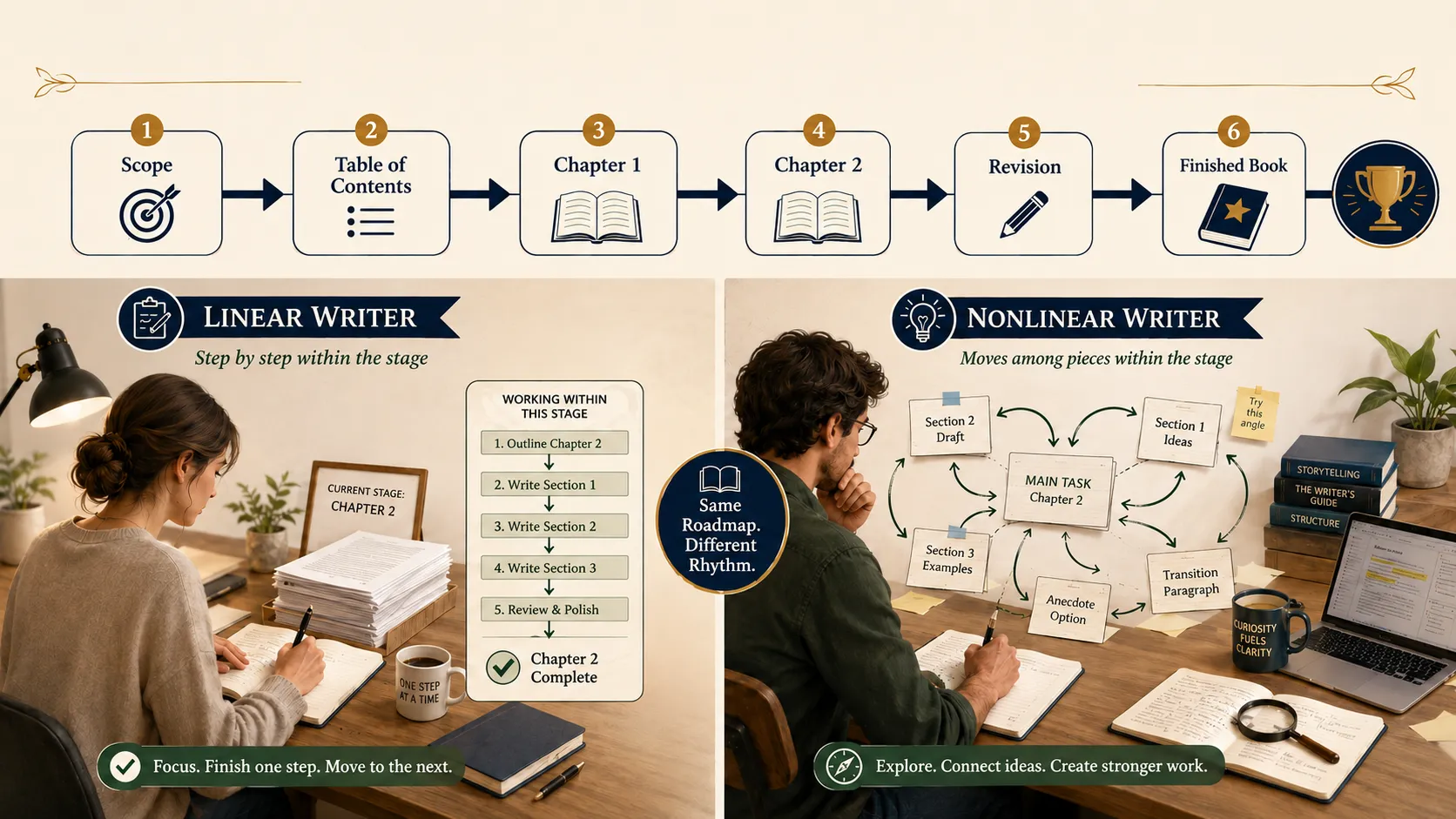
Nonlinear thinkers tend to experience the writing process as exploration, but that does not mean they need an unstructured process. They still benefit from a defined schedule and a clear sequence of milestones. They clarify the scope first, develop the table of contents next, write Chapter 1, then Chapter 2, and continue moving through the manuscript in order.
The difference appears in how they work within each stage.
When developing a table of contents, a linear thinker may begin at the top and work through each chapter in sequence until the outline is complete. A nonlinear thinker may develop the idea for Chapter 3, notice how it affects Chapter 1, add something to Chapter 5, and then return to refine Chapter 2. The writer is still completing the table of contents during the scheduled period, but the individual pieces may develop together rather than one at a time.
The same pattern can appear while writing a chapter. A nonlinear writer may work on one section for a while, pause to research a question that has emerged, move to another section where the ideas feel clearer, and then return to the earlier material with new insight. The sections do not necessarily have to be drafted from top to bottom, but they are all contributing to the same chapter.
From the outside, this movement can look less orderly than working down a checklist. Inside the writer’s mind, however, the pieces are often developing in relationship with one another. An idea discovered in one section may clarify another. A brief period of research may unlock the next part of the chapter. Moving between related tasks can help the writer remain engaged without losing the main focus.
The important point is that exploration happens within boundaries. The chapter still needs to be completed by the scheduled milestone. Nonlinear thinking changes the route through the work; it does not remove the destination or the deadline.
Structure and Working Style Are Not the Same Thing
It is easy to assume that linear writers need structure while nonlinear writers need freedom. In reality, both need structure. They simply use it differently.
The overall structure tells the writer what needs to be completed and when. The scope is completed before the table of contents. The table of contents is completed before chapter drafting begins. Chapter 1 is completed before the schedule moves to Chapter 2. Revision follows the completed draft.
A linear writer may move through each assignment in a step-by-step sequence, finishing one item and checking it off before beginning the next. A nonlinear writer may move among the different parts of the current assignment, allowing several pieces to develop at the same time.
For example, both writers may have the same deadline for completing Chapter 1. The linear writer may draft the opening section, finish it, move to the next section, and continue until the chapter is complete. The nonlinear writer may begin with the section that feels clearest, add notes to another section, conduct a small amount of research, return to the opening, and gradually bring the entire chapter together.
Both writers are following the same schedule. Both are completing the same chapter. The difference is not whether they are disciplined, but how they create progress.
Research Can Become a Trap for Either Style
Research does not necessarily reveal whether a writer is linear or nonlinear because both styles can remain in research far too long. The difference is often found in what the writer wants the research to provide.
A linear thinker usually researches in order to feel prepared. They want enough information to understand the subject, create a reliable structure, and move forward with confidence. The danger is that preparation can continue indefinitely because they never feel completely ready to begin.
A nonlinear thinker often researches because discovery is stimulating. One source leads to another, which opens a new question, which reveals an unexpected connection. The danger is that exploration itself becomes more enjoyable than deciding what belongs in the book and turning the discoveries into finished chapters.
One writer may be seeking stability, while the other is seeking fuel. Both can become stuck, even though the reasons for the delay are very different. That is why the most useful question is not how much research you do, but what you are hoping the research will give you.
Neither Style Is Better
Linear thinkers often build books by developing the structure and then filling it in. Nonlinear thinkers often discover books by gathering material and gradually recognizing the structure within it. One may want clarity before beginning, while the other finds clarity through movement.
Both approaches can produce excellent books. Both kinds of writers can create strong structure, communicate clearly, revise effectively, and finish their manuscripts. They simply may not reach the finished book in exactly the same way.
The problem begins when writers assume there is only one legitimate process. Much of the writing advice we receive is designed around a linear approach: outline everything, write the chapters in order, follow the plan, avoid distractions, and do not move on until the current section is complete.
That approach works beautifully for many writers. For others, it creates unnecessary resistance. A nonlinear writer using a rigidly linear method may begin to believe they are undisciplined, incapable of finishing, or simply bad at writing. They may feel guilty because they want to move to another chapter or pursue an idea that was not included in the original outline.
The desire to move among ideas is not automatically procrastination. Sometimes it is how the writer maintains interest, develops insight, and produces the strongest material. At the same time, a linear writer should not feel less creative because they want order and predictability. Their need for structure may be exactly what allows their creativity to flourish.
The goal is not to decide which style is superior. The goal is to understand what helps your mind do its best work.
Recognizing Your Own Style
You may lean toward linear thinking if you feel calmer when the book is organized, prefer to write in sequence, and want to know where you are going before you begin. You may lean toward nonlinear thinking if you naturally follow interesting threads, enjoy working on different parts of the book at different times, and often discover the structure by gathering and connecting pieces.
Many writers are a combination of both. You may think nonlinearly while gathering ideas but become highly linear during revision. You may want a clear table of contents while still preferring to draft the chapters out of order. You may explore widely at the beginning and become increasingly structured as the book takes shape.
The purpose of recognizing your style is not to place yourself into a permanent category. It is to understand what gives you energy, what creates resistance, and what kind of support will help you continue moving toward a finished book.
How This Fits the Create Great Books Process
The Create Great Books curriculum follows a defined path. You clarify the scope of the book, develop the table of contents, draft the chapters in sequence, revise the manuscript, and move toward completion. That order is intentional because a book needs both creative development and steady progress.
A nonlinear thinker does not need to abandon that path. In fact, the schedule and milestones can provide the boundaries that keep exploration from continuing indefinitely. The writer knows what the current assignment is, what must be completed, and when it is due.
Within that assignment, however, the writer has room to work naturally.
While developing the scope, you may move among the purpose, reader, outcome, boundaries, and future material until the full definition becomes clear. While creating the table of contents, you may develop several chapters at once, revisiting each one as the larger shape of the book emerges. While writing a chapter, you may move among its sections, research a question, add an example, and return to an earlier passage without requiring yourself to draft everything from beginning to end.
The milestone remains firm even when the path within it is flexible. By the end of the scheduled period, the scope needs to be complete, the table of contents needs to be ready, or the assigned chapter needs to be finished.
This allows nonlinear writers to work with their natural thinking style without allowing the book to become an endless collection of unfinished ideas.
Your Process Still Needs to Lead Somewhere
Understanding your thinking style is not permission to disregard the schedule, avoid decisions, or keep every possibility open. Linear writers may need to begin before they feel completely prepared. Nonlinear writers may need to stop exploring long enough to bring the current assignment to completion.
Both styles require deadlines, persistence, revision, and a willingness to finish. The difference is that they may organize the daily work differently.
A linear writer may see progress as a series of completed steps. A nonlinear writer may see progress as several developing threads that eventually come together. Both approaches can work, provided the writer continues reaching the required milestones.
Your process does not need to look like someone else’s process, but it does need to produce completed work. The purpose of understanding your thinking style is not to escape structure. It is to use structure in a way that helps you keep moving toward a finished book.
In the next post, I will look more closely at how linear and nonlinear writers can move through each stage of the writing process, along with the common traps that can prevent each kind of writer from finishing. Writers who have often felt that standard writing advice was created for someone else may finally begin to understand why.